Standardized multi-site substation control
Managing multiple substations across a wide geographic area creates significant operational challenges. Each site may run different equipment from different vendors, making it difficult to train staff, maintain consistency, and respond quickly to grid events.
COPA-DATA helps utilities address these challenges through vendor-independent software that standardizes operations across diverse hardware installations.
This guide explains
-
how to approach multi-site substation standardization,
-
what to consider when selecting automation software,
-
and how secure remote operation changes the way your engineering and automation teams work.
You'll find practical guidance on SCADA integration, cybersecurity requirements, and decision criteria for evaluating substation automation vendors.
Key takeaways: standardized multi-site substation control
- Standardizing substation control across multiple sites reduces training time and improves operator response during grid events.
- Vendor-independent software lets you connect equipment from different manufacturers into a single, unified control environment.
- Secure remote operation requires both network-level protections and application-level authentication developed following an IEC 62443-4-1 compliant SDL.
- COPA-DATA's zenon Energy Edition enables utilities to standardize operations while preserving existing hardware investments.
- SCADA integration connects your substations to regional and national control centers for improved visibility and coordination.
Why standardize substation control across multiple sites?
Substations acquired over decades often have different protection and control systems. This creates inconsistency in how operators interact with each site. A standardized approach means your team learns one interface, one alarm philosophy, and one command execution process.
Standardization also simplifies maintenance and upgrades. When you use common templates and configurations, changes made at one site can be replicated efficiently across your entire fleet. This reduces engineering hours and minimizes the risk of configuration errors.
For utilities managing dozens or hundreds of substations, standardization isn't optional - it's the foundation for reliable and efficient operations at scale.
What does vendor independence mean for substation automation?
Vendor independence means your automation software can communicate with Intelligent Electronic Devices (IEDs) from any manufacturer. You're not locked into a single equipment supplier for the lifetime of your assets.
This matters because substation hardware often lasts 20 to 30 years. During that time, you'll acquire equipment through different projects, inherit assets from mergers, or replace failed devices with whatever is available. Software that supports open standards like IEC 61850 lets you integrate all of it.
COPA-DATA's zenon connects to IEDs using IEC 61850, DNP3, IEC 60870-5-101/104, MODBUS, and other protocols. This broad connectivity means your automation layer remains stable even as the hardware underneath it changes over time.
How does secure remote operation work for substations?
Secure remote operation allows your team to monitor and control substations without traveling to each site. This is essential for utilities with geographically dispersed assets or substations in remote locations.
Security starts at the network level with encrypted communications and segmented networks. At the application level, role-based access control ensures that only authorized personnel can execute critical commands. Audit trails record every action for compliance and incident investigation.
The zenon software platform from COPA-DATA supports secure remote access with TLS encryption and authentication mechanisms aligned with IEC 62351. Your operators get the visibility they need without compromising security.
What role does SCADA integration play in multi-site control?
SCADA integration connects your substations to higher-level control systems. Regional control centers gain real-time visibility into grid conditions, while national operators coordinate load balancing and emergency response across the network.
Effective SCADA integration often uses gateway functionality to translate between local substation protocols and control center protocols such as ICCP/TASE.2. It also requires consistent data modeling so that alarms and measurements from different substations appear in a unified format.
zenon supports communication and data exchange with higher-level control systems (including bidirectional use cases depending on protocol and architecture) and helps maintain consistent data modeling through standardization. With standardized templates and data models, control room operators can work with a consistent view across different substation types - from smaller distribution sites to major transmission facilities.
What should you look for in substation automation software?
When evaluating substation automation vendors, focus on four areas: connectivity, engineering efficiency, cybersecurity, and scalability.
-
The software should support the protocols your current and future equipment uses. Native support for IEC 61850 is particularly important for digital substations.
-
Look for template-based configuration that lets you reuse work across sites. Object-oriented engineering and automatic project generation from IEC 61850 data models save significant time.
-
The vendor should follow a secure development lifecycle compliant with IEC 62443-4-1. Features like role-based access, encrypted communications, and security logging should be built into the platform.
-
The platform should handle small local substations and large control room SCADA equally well. Your needs will grow, and your software should grow with you.
Our Customers
How do utilities approach brownfield standardization?
Brownfield standardization means bringing existing substations into a common operational framework. You can't rip out working equipment, so the approach must be incremental.
Start by deploying a common automation platform that connects to your existing IEDs. Configure standardized displays, alarm lists, and command procedures. As you commission new sites or replace aging equipment, expand the standardization.
zenon supports this phased approach by integrating with legacy devices through conventional protocols while fully integrating IEC 61850 at new or upgraded sites. You maintain operational continuity while progressively modernizing your infrastructure.
What are the cybersecurity requirements for modern substations?
Substations are classified as critical infrastructure in most jurisdictions. Regulatory frameworks like NERC CIP in North America and the NIS2 Directive in Europe set specific cybersecurity requirements.
Key requirements include network segmentation, access control, continuous monitoring, and incident response procedures. Your automation software plays a central role by enforcing authentication, logging security events, and supporting patch management processes.
COPA-DATA follows an IEC 62443-4-1 compliant secure development lifecycle. This means security is designed into the software from the beginning, not added as an afterthought.
FAQs about standardized multi-site substation control in 2026
-
Standardized multi-site substation control means using common software, interfaces, and procedures across all your substations. This allows operators to work effectively at any site without relearning different systems.
COPA-DATA's zenon enables this by connecting to equipment from any vendor through a single, consistent platform.
-
Secure remote operation requires encrypted network connections, role-based user authentication, and detailed audit logging. Your software must enforce these controls while remaining usable for operators who need quick access during emergencies.
zenon supports security mechanisms such as TLS (e.g., IEC 62351-3 for TCP/IP-based connections), along with role-based access control and logging features to support secure operation.
-
Yes. Vendor-independent automation software abstracts the differences between equipment types. Your operators see a consistent interface regardless of whether the underlying IEDs use IEC 61850, DNP3, or legacy protocols.
COPA-DATA's zenon handles this integration automatically, presenting unified data to your operators and control systems.
-
Vendor-independent software connects to IEDs from different manufacturers using open communication standards. This protects your investment because you can change equipment suppliers without replacing your entire automation system.
zenon supports over 300 communication protocols, giving you the flexibility to integrate virtually any device.
-
SCADA integration gives control centers real-time visibility into all your substations. Operators can monitor grid conditions, coordinate responses to disturbances, and optimize power flows across the entire network from a central location.
-
Key standards include IEC 62443 for industrial cybersecurity, IEC 62351 for power system communication security, and regional regulations like NERC CIP or NIS2. Your automation software should support compliance with these frameworks.
COPA-DATA develops zenon using an IEC 62443-4-1 compliant secure development process.
In conclusion: building a standardized multi-site substation strategy
Standardized multi-site substation control delivers operational benefits you can measure: faster incident response, lower training costs, and more efficient engineering. The path forward involves selecting vendor-independent software, implementing secure remote operation, and integrating your substations into a unified SCADA hierarchy.
COPA-DATA's zenon gives you the connectivity, security, and engineering tools to standardize operations across any substation type - from legacy conventional installations to fully digital IEC 61850 sites. By choosing software that works with any hardware, you protect your existing investments while preparing for whatever the grid requires next.
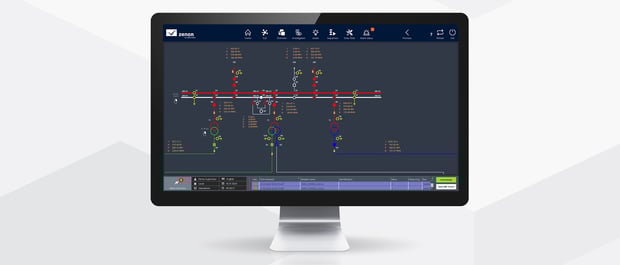
Application Set for Substation HMI
Your fast lane to set up projects easily and out of the box.