Connecting legacy pharma equipment to enterprise IT in 2026
This guide explains the key architecture, protocol, validation and implementation considerations for connecting legacy pharmaceutical equipment to enterprise IT in 2026.
Many pharmaceutical plants still rely on legacy manufacturing equipment that continues to perform reliably but lacks modern connectivity. This creates a gap between operational technology (OT) on the shop floor and enterprise IT systems such as MES, ERP and electronic batch records.
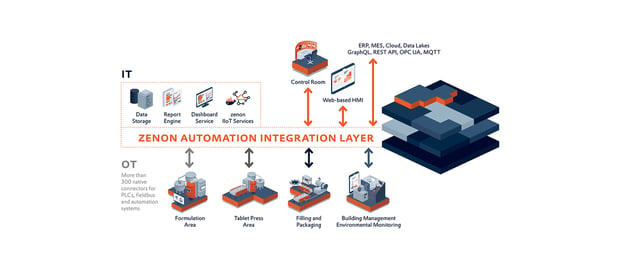
An Automation Integration Layer can bridge this gap without requiring manufacturers to replace working equipment. It connects legacy machines to modern IT systems, translates protocols, contextualizes data and supports data integrity and validation requirements.
Key takeaways
- An Automation Integration Layer connects legacy OT equipment with MES, ERP and other enterprise systems.
- Legacy equipment can often be integrated without replacing or modifying validated control systems.
- Protocol requirements range from RS-232 and RS-485 to proprietary protocols, OPC and OPC UA.
- Data mapping and contextualization are essential for turning raw equipment data into usable manufacturing information.
- Software built on GAMP 5 Category 4 principles can reduce validation effort because it is configured rather than custom coded.
- FDA 21 CFR Part 11, EU GMP Annex 11 and ALCOA+ principles must all be considered when integrating systems that handle GxP data.
- A phased approach can reduce implementation and validation risk.
These companies use zenon
What is an Automation Integration Layer?
An Automation Integration Layer is middleware between manufacturing equipment and enterprise IT systems. It collects data from machines, translates communication protocols, adds context and delivers information to systems such as MES, ERP and electronic batch record platforms.
For pharmaceutical manufacturing, the integration layer must do more than move data. It should help preserve data integrity, provide appropriate access controls and audit capabilities, and maintain the context needed to understand each data point.
For example, a temperature value of 72.5 is not meaningful on its own. The enterprise system may need to know the equipment, batch, process step, timestamp, unit and data quality associated with that value.
OT/IT architecture for legacy pharma equipment
A useful way to understand the architecture is through the ISA-95 hierarchy, the international standard for enterprise-control system integration:
- Level 0: Physical processes and sensors
- Level 1: PLCs and controllers
- Level 2: HMI and supervisory control
- Level 3: Manufacturing operations and integration
- Level 4: Enterprise systems such as ERP
Legacy equipment typically operates at Levels 0 to 2. The integration layer connects these systems with Level 3 and Level 4 applications.
This is particularly important in brownfield environments, where existing equipment and validated processes must remain operational. A non-invasive approach can often collect data through existing interfaces without changing control logic.
Choosing protocols for legacy equipment
The communication protocol depends largely on the age and manufacturer of the equipment. A modern integration platform can connect to different protocols without requiring the entire plant to standardize its existing equipment.
|
Protocol type |
Typical equipment age |
Common use case |
Integration consideration |
|
RS-232 / RS-485 (serial) |
Oldest |
Lab instruments, scales, older PLCs |
Often needs a serial-to-Ethernet converter to reach the network |
|
Proprietary manufacturer protocols |
Mixed |
Vendor-specific PLCs and controllers |
Usually requires a protocol-specific driver |
|
Fieldbus standards |
Mid-generation |
PLCs and distributed control systems |
Driver availability varies by vendor |
|
OPC (Classic) |
Mid to newer |
SCADA and HMI systems |
Widely supported, being phased out in favor of OPC UA |
|
OPC UA |
Newer / current |
Modern PLCs, SCADA, IIoT devices |
Preferred for new equipment specifications; adds security and information modeling |
OPC UA and Modern Connectivity OPC UA, maintained by the OPC Foundation, is particularly useful for modern industrial integration because it supports standardized data exchange, security and information modeling.
However, OPC UA does not eliminate the need to integrate older equipment. Legacy devices may still require serial connections, proprietary drivers or protocol converters.
Data mapping and contextualization
Legacy equipment often produces data in inconsistent formats. Values may use different units, timestamps or naming conventions.
Data mapping converts these values into a consistent information model. It can include:
- Unit conversion
- Scaling
- Timestamp normalization
- Quality codes
- Equipment hierarchies
- Batch and process context
Good data mapping is essential because errors introduced at the integration layer can affect downstream systems and validation activities.
Validation and compliance considerations
Validation should be considered from the beginning of an OT/IT integration project.
The required effort depends on the system's intended use, risk assessment, configuration and software approach. Configurable platforms can reduce the need for custom development, but the specific implementation still needs appropriate qualification and validation.
GAMP 5 software categories
GAMP 5, published by ISPE, categorizes software based on its configurability and intended use. Category 1 covers infrastructure software such as operating systems. Categories 3 and 4 address configurable software, and Category 5 covers custom applications.
Category 4 software, meaning configured applications, generally requires less validation testing than Category 5 custom software. The organization deploying the software tests its specific configuration rather than the underlying platform functionality, since the vendor has already validated the platform itself. This is why platforms built to meet GAMP 5 Category 4 principles can reduce the validation burden compared with custom-coded integration solutions.
FDA 21 CFR Part 11
FDA 21 CFR Part 11establishes the criteria under which electronic records and electronic signatures are considered trustworthy and equivalent to paper records and handwritten signatures. Relevant controls include system validation, secure audit trails, access controls through unique user credentials, and electronic signature integrity. The integration layer should preserve the integrity and traceability of regulated data throughout its lifecycle.
EU GMP Annex 11
EU GMP Annex 11 addresses computerized systems used in pharmaceutical manufacturing in the EU market. The European Commission and PIC/S published a draft revision on July 7, 2025, expanding the guideline from 5 pages to 19 pages across 17 chapters, alongside a new Annex 22 covering artificial intelligence. Public consultation on the draft closed in October 2025, and the final version is expected to be published in mid-2026.
The draft strengthens requirements around cybersecurity, supplier and service management, identity and access management, and audit trails, while formalizing ALCOA+ as a core data integrity principle. Manufacturers selling into the EU market should treat the current version as the baseline and monitor for the final publication.
ALCOA+
ALCOA+ describes key characteristics of reliable pharmaceutical data: Attributable, Legible, Contemporaneous, Original, Accurate, Complete, Consistent, Enduring and Available. An integration architecture should preserve these characteristics as data moves from equipment to enterprise systems.

Common integration challenges
-
Older devices may only provide serial interfaces. Serial-to-Ethernet converters or additional data collection hardware can provide connectivity where appropriate.
-
Different machines may use different units, timestamps and alarm conventions. A central integration layer can normalize this information before it reaches enterprise systems.
-
Connecting validated equipment introduces change-control considerations. Non-invasive data collection can reduce the impact, but every implementation should follow the site's quality and validation procedures.
How zenon can support legacy equipment integration
The zenon Software Platform from COPA-DATA can function as an Automation Integration Layer between manufacturing equipment and enterprise IT.
It includes more than 300 native communication drivers covering equipment from a wide range of automation vendors, which can reduce or remove the need for additional protocol converters for many legacy devices. zenon can connect equipment data with systems such as MES, ERP and historians, and it supports functionality for audit trails, electronic signatures, user management and data integrity requirements in pharmaceutical applications. zenon is classified as GAMP 5 Category 4 software.
In practice, this means integration solutions are built through configuration rather than custom code, which can reduce the validation testing required for a given deployment compared with fully custom-built integration software.
How to future-proof your integration architecture
A successful integration strategy should support both current and future equipment.
When purchasing new equipment, define connectivity requirements in advance and prefer standardized interfaces such as OPC UA where appropriate.
Your architecture should also be scalable so that an initial pilot can expand to additional production lines without requiring a completely different integration approach.
Finally, review regulatory and technology changes regularly and maintain the integration environment through appropriate change control and lifecycle management.
Conclusion
Connecting legacy pharmaceutical equipment to enterprise IT does not necessarily require replacing existing machinery. A well-designed Automation Integration Layer can connect different equipment protocols, contextualize manufacturing data and provide interfaces to MES, ERP and other enterprise systems.
The most effective approach is to begin with an equipment and data assessment, design a risk-based architecture, pilot the integration and then scale it across the plant.
For pharmaceutical manufacturers, connectivity is only part of the solution. Data integrity, validation, security and regulatory requirements must be considered throughout the integration lifecycle.
FAQs
-
An Automation Integration Layer connects manufacturing equipment with enterprise systems such as MES and ERP. It translates protocols, collects and contextualizes data, and transfers information between OT and IT systems.
-
Common options include RS-232, RS-485, proprietary protocols, Ethernet, OPC and OPC UA. The appropriate protocol depends on the equipment and integration architecture.
-
The integration layer may handle regulated data and therefore needs to be assessed as part of the computerized system. Validation scope depends on intended use, risk, configuration and applicable quality requirements.
-
Brownfield integration connects existing equipment and systems, often with significant legacy constraints. Greenfield projects allow connectivity and architecture to be designed from the beginning.
-
Often, yes. Existing communication interfaces can be used to collect data without replacing equipment. The appropriate approach depends on the machine's interfaces, architecture and validation requirements.
-
GAMP 5 Category 4 software is typically configured rather than custom developed. This can reduce the amount of bespoke software development and associated verification compared with custom-coded solutions, although the configured application still needs to be assessed and validated according to its intended use and risk.
-
The integration architecture should preserve data attributes such as attribution, accuracy, contemporaneous recording, completeness, consistency and availability as information moves from equipment to enterprise systems.
-
An integration layer can extend the useful life of existing equipment while providing access to its data. This can avoid unnecessary equipment replacement and allow connectivity projects to be implemented incrementally.