GMP Automation Integration Layers for EBR in the US

For US life sciences manufacturers, connecting shop-floor equipment to electronic batch records (EBRs) and enterprise systems like MES and ERP is no small feat. Compliance requirements   including FDA 21 CFR Part 11 and EU GMP Annex 11 add complexity to every integration project. A GMP-compliant automation integration layer can simplify this challenge significantly.

GMP_FDA_Herobanner_1420x757px
Home Industries Life Sciences & Pharmaceutical Automation Integration Layer GMP Automation Integration Layers for EBR in the US
media2boxes_1760x755px_PharmaHMI

COPA-DATA helps manufacturers bridge the gap between operational technology (OT) and IT infrastructure with the zenon Software Platform.

In this guide, you'll discover

  • what automation integration layers are,

  • why they matter for EBR data capture,

  • and how to evaluate these solutions for your facility.
Key takeaways

Key takeaways: GMP Automation Integration Layers for EBR in the US

  • A GMP-compliant automation integration layer connects plant-floor equipment to MES and ERP systems while meeting regulatory requirements.
  • Electronic batch records (EBRs) require accurate, real-time data capture from multiple sources to support faster batch release and review by exception.
  • COPA-DATA's zenon software meets GAMP 5 Category 4 requirements and supports full FDA 21 CFR Part 11 compliance out of the box.
  • Hardware-independent, software-based integration layers offer greater flexibility compared to proprietary bundled systems.
  • Choosing the right integration layer can reduce validation time, cut manual data entry errors, and shorten time to market.

What is a GMP-compliant Automation Integration Layer?

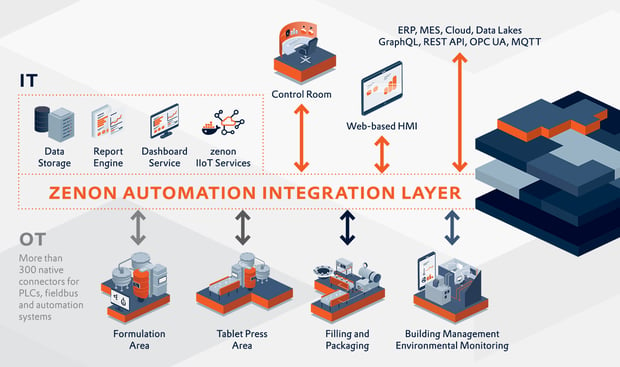
A GMP-compliant automation integration layer is a software middleware that sits between your plant-floor equipment (level 0–2 of the ISA-95 model) and your enterprise systems like MES and ERP (level 3–4). It captures, consolidates, and routes operational data while maintaining the data integrity standards required by GMP regulations.

For pharmaceutical and biotech manufacturers, this layer handles critical tasks: collecting process parameters from reactors, capturing weigh-dispense data, recording environmental monitoring values, and passing this information to your EBR and MES systems. The key distinction is that GMP-compliant solutions come with built-in features like audit trails, electronic signatures, and user access controls aligned with FDA 21 CFR Part 11.

Why does EBR data capture require a dedicated Integration Layer?

EBR systems depend on accurate, timestamped data from dozens sometimes hundreds of data points across your production floor. Without a dedicated integration layer, you face manual data entry, disconnected data silos, and the risk of transcription errors that can delay batch release or trigger regulatory findings.

A purpose-built integration layer automates this data flow. It pulls values directly from PLCs, SCADA systems, scales, and environmental sensors, then formats and delivers that data to your EBR system in real time. This approach supports "review by exception," where quality teams focus on flagged anomalies rather than reviewing every data point manually.

According to industry research, manufacturers that move from manual batch records to MES with integrated EBR have seen batch throughput increases of more than 50% with the same staff demonstrating the efficiency gains possible with proper integration architecture.

How do Automation Integration Layers support MES and ERP connectivity?

MES and ERP systems need production data to function properly. Your MES requires real-time information about batch status, equipment availability, and process deviations to manage manufacturing operations. Your ERP system needs accurate production quantities, material consumption data, and quality results to maintain inventory and plan future orders.

An automation integration layer acts as the data highway between these systems. It standardizes data formats, handles communication protocols, and ensures that information flows bidirectionally—from the plant floor up to enterprise systems, and from enterprise planning back down to operators on the floor.

COPA-DATA's zenon Software Platform connects to more than 300 different communication drivers, making it possible to integrate legacy and modern equipment into a unified data architecture without requiring expensive hardware replacements.

  • Content_small_1350x800px_AIL-1
    • Content_small_1350x800px_AIL-1

      What regulatory requirements must an Integration Layer meet?

      For US pharmaceutical manufacturers, FDA 21 CFR Part 11 establishes the framework for electronic records and signatures. Your automation integration layer must support secure audit trails, electronic signature capture, and user authentication to meet these requirements.

      Equally important is the GAMP 5 framework, which categorizes software according to validation requirements. GAMP 5 Category 4 software refers to configurable products that can be validated through documented configuration rather than full custom code testing. This designation significantly reduces validation effort and cost compared to custom-built solutions.

      zenon from COPA-DATA qualifies as GAMP 5 Category 4 configurable software, meaning you can validate your specific configuration rather than the entire platform codebase. The software also includes built-in compliance features for EU GMP Annex 11, making it suitable for global manufacturing operations.

      key features

      What are the key features to look for in an Integration Layer?

      • Your integration layer needs to communicate with every piece of equipment on your production floor. Look for solutions with extensive native driver libraries that cover both modern and legacy systems. The ability to connect to older equipment is particularly important in brownfield facilities where replacing hardware is not practical.

      • Features like timestamped audit trails, configurable user access controls, and electronic signature workflows should come standard not as expensive add-ons. These capabilities are essential for meeting Part 11 and Annex 11 requirements without custom development.

      • Raw data values are only useful when combined with context. Your integration layer should tag data with equipment identifiers, batch numbers, timestamps, and user information to create a complete record suitable for trending, analysis, and regulatory review.

      • As your operations grow, your integration layer should scale accordingly. Consider solutions that support multi-site deployments with centralized management and standardized configurations across facilities.

      How does hardware independence benefit your integration strategy?

      Traditional industrial automation systems often bundle hardware and software together from a single vendor. This approach can limit your flexibility and create long-term dependency on a specific supplier's product roadmap and pricing.

      A hardware-independent, software-only integration layer gives you freedom to choose the control hardware that fits your process requirements. You can mix equipment from different manufacturers, integrate legacy systems alongside new installations, and upgrade individual components without rebuilding your entire automation architecture.

      COPA-DATA's software-first approach exemplifies this strategy. The zenon platform is designed to work with any standard industrial hardware, giving you the flexibility to design your automation system around your process needs rather than vendor constraints.

      What role does an Integration Layer play in batch release efficiency?

      Batch release is often the bottleneck in pharmaceutical manufacturing. Quality teams must review extensive documentation before a batch can ship, and any gaps or errors trigger investigations that delay release.

      An effective integration layer accelerates batch release in two ways. First, it eliminates manual data transcription the primary source of documentation errors. Second, it enables real-time data access during production, allowing quality personnel to monitor batches and address exceptions as they occur rather than discovering problems after the fact.

      This "review by exception" approach has been shown to dramatically reduce batch release cycle times. When your batch record is complete and accurate the moment production ends, you remove days or weeks from your release timeline.

      How do you evaluate Integration Layer vendors for Life Sciences manufacturing?

      Start by assessing regulatory fit. Does the vendor have a documented history of installations in FDA-regulated facilities? Can they supply validation documentation packages and evidence of compliance with Part 11 and Annex 11? Ask for references from pharmaceutical or biotech customers with similar production environments.

      Next, evaluate technical fit. Map out your current equipment landscape and verify that the solution covers your communication needs. Consider future equipment purchases and ensure the platform can accommodate growth without major architectural changes.

      Finally, examine the vendor's support model. Pharmaceutical manufacturing runs around the clock, and you need a partner who can respond quickly when issues arise. Look for vendors with established life sciences expertise and global support capabilities.

      Our Customers

      • DrReddys_reference_logo_480x300px
      • HarroHoefliger_reference_logo_480x300px
      • BoehringerIngelheim_reference_logo_480x300px
      • Novartis_reference_logo_480x300px
      • RocheDiagnostics_reference_logo_480x300px
      • Romaco_reference_logo_480x300px
      • Skan_reference_logo_480x300px
      • BauschStroebel_reference_logo_480x300px
      • AstraZeneca_reference_logo_480x300px
      • Sanofi_reference_logo_480x300px
      • Lifescan_reference_logo_480x300px
      • ACGWorldwide_reference_logo_480x300px
      • Biotree_reference_logo_480x300px
      • Pfizer_reference_logo_480x300px
      • BrevettiCEA_reference_logo_480x300px
      • ImaPharma_reference_logo_480x300px
      • Baxter_reference_logo_480x300px
      • MuellerCleaning_reference_logo_480x300px
      • Merck_reference_logo_480x300px
        Contact us

        In Conclusion: Choosing the right Automation Integration Layer for your facility

        GMP-compliant automation integration layers are essential for US life sciences manufacturers who need to capture accurate EBR data and connect plant-floor systems to MES and ERP. The right solution reduces validation burden, eliminates manual data entry errors, and accelerates batch release.

        When evaluating options, prioritize regulatory compliance features, hardware independence, and driver coverage. Solutions like COPA-DATA's zenon offer the GAMP 5 Category 4 validation pathway and built-in Part 11 compliance that pharmaceutical manufacturers require. By selecting a flexible, software-based integration layer, you position your facility for long-term success - able to adapt to new equipment, new regulations, and new production demands without starting from scratch.
        Contact_Image_890x485px_LifeScienceTeam
        Life Sciences & Pharmaceutical | Process Industry
        Industry Management
        Contact us
        FAQs

        FAQs about GMP Automation Integration Layers for EBR in the US

        • An automation integration layer focuses on data acquisition and connectivity between shop-floor equipment and IT systems. MES (Manufacturing Execution System) manages broader manufacturing operations including scheduling, work orders, and batch execution. Many facilities use both, with the integration layer feeding data to the MES.

        • Yes, a well-designed integration layer connects to both modern and legacy equipment. COPA-DATA's zenon supports over 300 native communication drivers, enabling you to integrate older PLCs and instrumentation alongside newer systems without costly hardware replacements.

        • GAMP 5 Category 4 refers to configurable commercial software. Unlike custom-coded solutions, Category 4 software can be validated through documented configuration testing rather than full source code review. COPA-DATA's zenon meets this classification, significantly reducing your validation time and cost.

        • Yes, COPA-DATA's zenon includes built-in features for Part 11 compliance, such as secure audit trails, electronic signatures, and configurable user access controls. As a GAMP 5 Category 4 solution, zenon reduces validation complexity while meeting regulatory requirements.

        • The integration layer captures data directly from equipment and sensors, eliminating manual transcription. This automated approach removes the human errors -transposed numbers, missed entries, illegible handwriting - that frequently cause batch record discrepancies and regulatory findings.

        • Review by exception is a quality approach where reviewers focus on flagged anomalies rather than reviewing every data point. A good integration layer captures real-time data, applies defined limits, and highlights exceptions automatically   enabling faster, more focused batch review.

        Key takeaways
        I'm COPA-DATA's AI Assistant and happy to help with general info. Got any questions?