
zenon as AI enabler
How the zenon software platform enables AI-powered projects in your automation applications
Successful AI projects in industrial automation require more than artificial intelligence: the zenon Software Platform provides the data foundation, connectivity, and openness needed to put AI into practice.
AI has long since found its way into all areas of technological activity. The use of AI also offers numerous opportunities for development in industrial automation and the automation of energy infrastructure facilities—whether through faster project planning during the creation and maintenance of applications, through efficiency gains during ongoing operations, or through AI-driven process optimizations.
The possibilities opened up by artificial intelligence are virtually limitless. But only if the framework conditions are right—clear governance, a solid data foundation, interfaces that ensure a certain level of secure openness, and a software platform that serves as a central hub for all areas.
Data is the foundation of all AI applications – zenon as a data provider
AI can only deliver results as good as the data fed into it allows. What has always set zenon apart is now taking on even greater significance: the collection and contextualization of data from the operational environment.
-
Openness and flexibility when integrating data sources
With over 300 drivers, zenon enables you to retrieve, store, and process data from any equipment in a facility. This is particularly useful for highly heterogeneous brownfield facilities featuring equipment from different manufacturers, different technology generations (i.e., legacy systems alongside high-tech industrial solutions), and various business units (production line management, building automation, or internal corporate energy infrastructure), all of which can be consolidated into a single system. In zenon, the collected data is standardized, centrally stored within a single system, managed, and if necessary tagged with metadata.
-
Reliable Data Collection
Data integrity, as found within the zenon software platform, enables seamless and accurate data recording. Proven redundancy mechanisms, event buffering capabilities, and other features support the seamless recording of data, which later serves as the basis for AI. After all, the higher the quality of the collected data, the better the results generated by the AI later on.
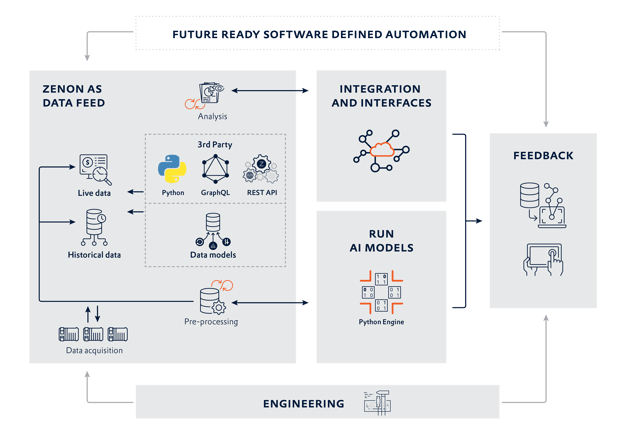
Building on a clean database, the data can be retrieved by various interfaces. For example, the available Python interface allows AI agents to access the data for further applications. Other interfaces, such as GraphQL or the REST API, also provide comprehensive data analysis capabilities using the zenon environment.
AI in Production - Four Fallacies that can derail your data
Read how you can improve data quality in order to get the most out of the interaction between OT, historian archives, and AI.
-
AI delivers reliable operational benefits when it is built on a well-maintained, contextualized database. This is exactly where zenon comes in as the enabler that transforms data into actionable information.

Lukas Punzenberger | Director Product Management | COPA-DATA
COPA-DATA Trust Center
COPA-DATA also takes cyber security very seriously within its own organisation. Find out more, how the company makes sure, that data, as well as intellectual property is secured.
How does zenon connect to external AI tools?
zenon’s open architecture not only enables flexible data retrieval from the operational level but also allows information to be passed on to third-party systems, such as analytics tools. This takes IT-OT convergence to the next level.
The third-party interfaces available in zenon for Python, GraphQL, or the REST API make it possible to make data from the OT world usable for the IT world and its AI applications. Data models as well as LLMs can thus be fed with data from production.
The insights gained from these applications are fed back through the zenon software platform as concrete application optimizations to the operational or control level.
Inspirational examples of such applications could include:
- An AI-powered operator guide for handling specific events
- Automated operator actions performed by AI
- AI-supported process optimizations
and much more. Future ideas, such as voice control in the Service Engine, could provide additional support to users.
Data Directly from Production to AI
Artificial intelligence can be fed not only with data from databases and archives, but data can also be retrieved directly at the operational level using zenon Logic. The zenon Logic Python Engine provides a process-oriented interface at the PLC level that enables machine learning with hardware requirements that are as resource-efficient as possible. The customized models can be run either at the edge or in the cloud. The algorithm can be easily integrated there and optimized for your specific use case. This allows AI to detect anomalies or opportunities for production optimization. By combining real-time process data with intelligent algorithms, AI in manufacturing enables smarter, more flexible, and more efficient production processes through data-driven decision-making and continuous optimization.
Example applications—which in turn feed directly into the process and further develop and improve production processes—include:
- Calculation and management of peak loads in the energy sector, or
- Predictive maintenance applications.
What role do zenon and AI play in software-defined automation?
Based on the software-defined automation philosophy, rigid OT structures can be broken down and brought closer to the IT infrastructure. Thanks to various interfaces and APIs, it is possible to provide AI models (LLMs) with data from the zenon environment, thereby enabling them to execute processes effectively.
AI as an engineer’s helping hand
The zenon Engineering Assistant was created to support project developers in implementing zenon projects. The Engineering Assistant draws on the collective zenon expertise found in the online Help, the zenon Academy, the tutorial videos, and the Knowledge Base. This ensures that the knowledge accessed by the zenon Engineering Assistant is always up to date.
The Engineering Assistant already supports project designers when questions or uncertainties arise during project planning with zenon. However, development is ongoing, and our product development team’s ambitions are focused on automated project creation, PLC code generation, and test processes powered by AI.
FAQs
-
zenon is an AI enabler because it provides the reliable data foundation, open interfaces, and IT-OT connectivity needed to integrate AI into industrial automation. With over 300 drivers, zenon collects, contextualizes, homogenizes, and centrally manages data from heterogeneous industrial systems. Its data integrity and redundancy mechanisms support reliable, high-quality data acquisition for AI applications.
-
The zenon software platform offers third-party interfaces for Python, GraphQL, or the REST API. With these, data from the automation environment are made usable for the IT world and its AI applications, e.g. for analytics tools.
-
zenon enables AI integration between IT and OT systems through its open architecture and interfaces such as Python, GraphQL, and REST APIs. These allow production data from OT systems to be integrated into IT applications, analytics tools, and AI models, including LLMs. The resulting insights can then be fed back into the operational or control level to optimize production processes.
-
Potential use cases for AI-powered applications implemented with the zenon Software Platform include predictive maintenance, peak load calculations in energy automation, and anomaly detection. Other applications include AI-driven process optimization and intelligent operator guidance.
-
With it’s 300+ drivers the zenon product platform can connect to a vast majority of industrial equipment and draw data from nearly every data source in industrial automation. Once the data is available in the zenon project environment, it can be contextualized and used for further projects using AI.
-
Yes! With drivers available for all common equipment zenon can connect also very heterogeneous production environments. Data is standardized and harmonized, so they can be used for further processing and analysis, including AI supported applications.
-
With zenon Logic, production data can be retrieved directly at the operational level. The zenon Logic Python Engine enables machine learning directly at the PLC level through a process-oriented interface designed to minimize hardware resource requirements.
We are happy to support you
If you’d like to discuss about AI applications with zenon, you can of course contact your local sales representative. The COPA-DATA sales team will be happy to share ideas and provide you with information.