Visualization of baggage handling systems for Fraport
Success Story
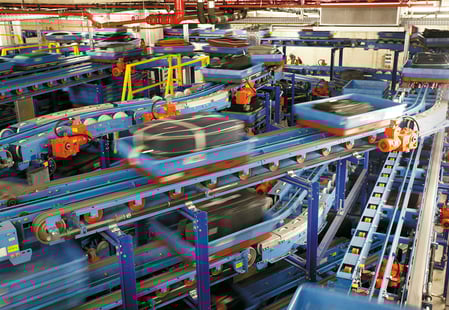
Fraport AG is one of the world’s leading airport operators. At Frankfurt Airport, a central aviation hub in Europe, one of the most complex baggage handling systems in the world ensures that millions of pieces of luggage every year are sorted and delivered accurately and efficiently. In order to meet this logistical challenge with state-of-the-art technology, Fraport has completed an end-to-end modernization of the visualization system using zenon from COPA-DATA.
With more than 61 million passengers per year, Frankfurt Airport is one of Europe's busiest international aviation hubs. This volume of passengers requires Fraport to operate one of the world's largest and most efficient baggage handling systems (BHS). It ensures that the airport’s luggage moves smoothly.
The current BHS is approximately 81 km long and includes some 22,500 electrical drivers. When Terminal 3 opens, the system will increase to around 100 km in length and the number of drivers will grow to around 26,500. On peak days, more than 120,000 pieces of luggage are sorted and distributed automatically at a travel speed of 18 km/h. An outage in the BHS could have major repercussions for the entire airport, its operations, and its passengers.
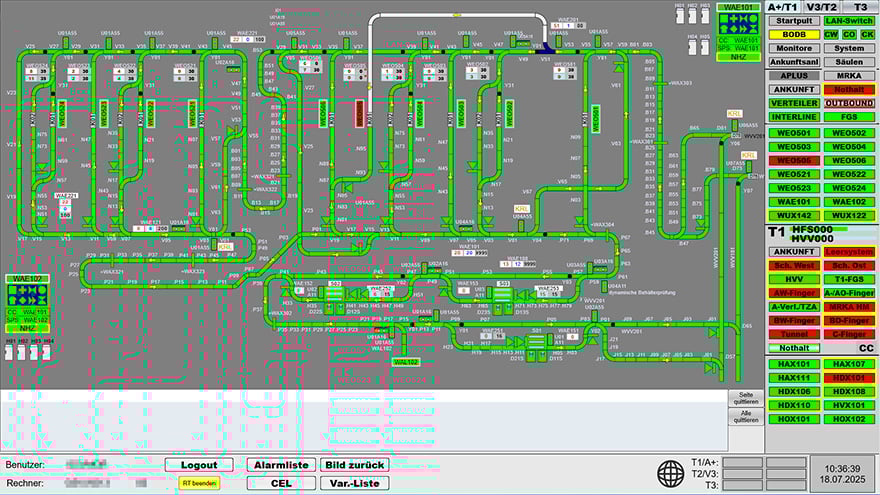 The first gate in Terminal 1 visualized with zenon, including incoming and outgoing conveyor lines and collection points.
Before launching the project, the Baggage Control Center was working with three different software solutions to provide visualization, control the BHS, and display baggage carousels for arrivals. This fragmented approach led to significant extra work and high maintenance costs.
The analog MOSAIK display panels running legacy software were also a challenge for the team. Third-party providers were needed to make changes. This resulted in additional costs, longer lead times, and a lack of flexibility. In addition, the physical scalability of the MOSAIK interface had reached its limit. When new terminal areas went live, such as Gate A-Plus, the new system components could not be displayed.
With ongoing modernization activities and additions to the BHS, Fraport regularly needed to make changes to the visualization and control systems. The legacy systems were too inflexible to support these necessary changes easily. Considerable work was required to meet requirements.
To attain the necessary agility and scalability, the Fraport team wanted to transfer all sub-areas of the BHS to a centralized visualization system. After thorough evaluation, Fraport chose zenon – the modular, scalable platform from COPA-DATA. zenon’s open architecture and wide range of standard functions impressed the airport operator.
The project was implemented successfully with 61 structured sub-projects. It currently includes more than 1.37 million tags and around 680 programmable logic controllers (PLCs). System communication is supported by approximately 160 drivers. The majority of functions could be implemented using standard zenon functions. More complex requirements, such as special process logic, were implemented using add-ins and the programming interface (API) in C#.
“Dr. Matthias Oertel from our system integrator partner Helix supported us in implementing additional programming. Even during peak times, we could count on the Helix team to support with project planning,” says Alex Fuchs, FGS Research and Industrial Initiative Engineer at Fraport.
Sebastian Spitzbart, fellow FGS Research and Industrial Initiative Engineer at Fraport, adds, “Thanks to zenon's wide range of functions, such as its numerous available drivers and a flexible programming interface, we can customize the system to closely meet our unique requirements and integrate it optimally in our existing infrastructure. This has also allowed us to respond to feedback from operating personnel in the Baggage Control Center to customize the visualization system to better meet their needs.”
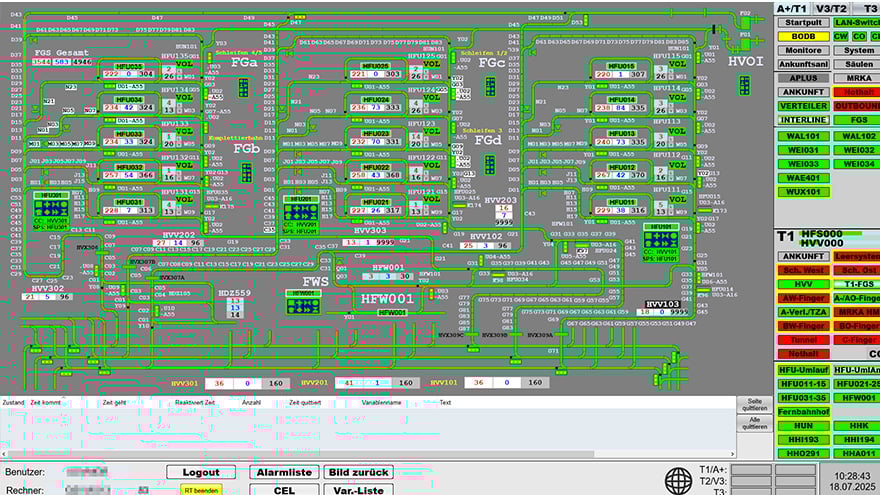 Dynamic early baggage storage system in Terminal 1, consisting of 15 separate storage loops and a higher-level circulation loop to provide baggage buffering on a demand-driven basis.
In an airport, where infrastructure runs around the clock, undertaking modernization projects during live operations is extremely challenging and requires precise planning and close coordination between all stakeholders.
It was vital to transition to the new system seamlessly without disrupting daily airport operations. To achieve this, the zenon-based visualization system was initially set up in parallel with the legacy system. It was then tested extensively. Only when all the functions were running error-free did the team finally decommission the wall of legacy MOSAIK systems.
Since then, the visualization has been running on state-of-the-art 86-inch and 42-inch monitors on a video wall in the Baggage Control Center, as well as on 16 operator workstations, each equipped with three monitors.
By switching to zenon, Fraport was able to centralize its entire BHS and significantly improve the system’s operating efficiency. It is now possible to adjust visualizations or system structures inhouse. Fraport no longer relies on third-party service providers. This saves costs, accelerates project cycles, and reduces response times in the event of a breakdown. System scalability is also enhanced. It will now be much easier to add new terminal areas.
A major advantage of the new solution is that it improves operational monitoring thanks to all the status and process information provided by zenon. zenon makes it easy to quickly detect and troubleshoot sources of error.
“This project has modernized and streamlined the system landscape significantly. zenon has enabled us to replace the previous fragmented, multi-system approach with a centralized, end-to-end solution,” says Sebastian Spitzbart.
Alex Fuchs adds, “The zenon platform is also highly scalable – and future functionality can be integrated seamlessly.”
Originally planned only as a solution for visualization, zenon is now much more than an HMI. Fraport’s deployment of zenon enables users to control switches, activate scanning points, and monitor further components. The customer will also be able to integrate predictive maintenance concepts in the future. As a result, zenon is already doing much more than set out in the original project scope. zenon provides the digital backbone for BHS monitoring and will provide BHS visualization for the new Terminal 3 when it is completed.