Kyowa Kirin builds a future-ready factory with zenon
Success Story

The Kyowa Kirin Group is a Japan-based specialty pharmaceutical company. It strives to contribute to the health and wellbeing of people around the world by creating new value through the pursuit of advances in life sciences and technologies. To meet the modern requirements of the pharmaceutical sector, including smoothing the transition from early-stage process development to GMP manufacturing and meeting increasingly stringent data integrity (DI) requirements, Kyowa Kirin worked with system integrator SOFTECH CO.,LTD to implement the zenon software platform from COPA-DATA at its Takasaki manufacturing plant.
Kyowa Kirin uses zenon to build a future-ready factory:
The Kyowa Kirin Group was formed by the merger of Kyowa Hakko Kogyo and Kirin Pharma. Its history dates back to 1949 and, today, its global locations employ nearly 5,700 people. Kyowa Kirin has two key production bases in Japan: Takasaki City, in Gunma Prefecture, and Ube City, in Yamaguchi Prefecture. The Takasaki Plant, some 100km northwest of Tokyo, manufactures and formulates bulk pharmaceuticals for investigational drugs and marketed products.
As the requirements around data integrity compliance have grown within the pharmaceutical industry, regulatory authorities have required enhanced data integrity in pharmaceutical operations. To meet these increasingly stringent essential conditions, Kyowa Kirin is investing in automation and digitalization.
At Takasaki, Kyowa Kirin has invested 16.8 billion Japanese yen ($118 million) in a new, state-of-the-art active pharmaceutical ingredient (API) manufacturing facility. Construction was carried out by Kirin Engineering Company and Taisei Corp and includes space for future expansion.
The existing systems used at Takasaki did not provide the required high level of DI compliance or connectivity for a digital factory. Connecting to individual devices is difficult, limiting data collection and connection between devices.
For the new building, Kyowa Kirin needed a future-ready SCADA system which would resolve connectivity issues, ensure good operability and visibility and enhance data availability and management. It chose the zenon software platform from Austrian industrial software specialists COPA-DATA.
“zenon has a proven track record of implementation at many pharmaceutical companies both domestically and internationally,” explains Hiroaki Iwama, Manufacturing Division, Takasaki Plant Engineering Department at Kyowa Kirin. “We knew zenon would meet our DI requirements while providing open connectivity, scalability, and potential for future expansion, including with higher-level systems.”
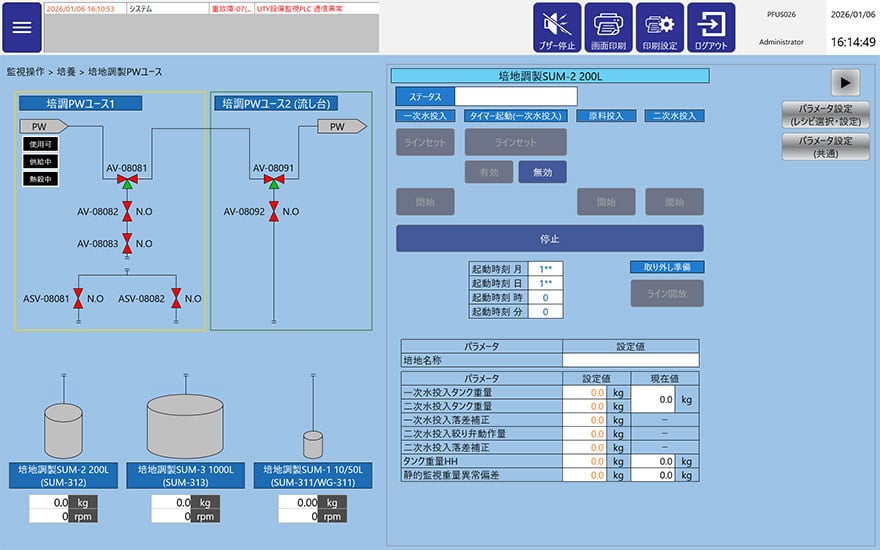
Example screens for configuration and operation of cultivation equipment
The new HB7 building at Takasaki spans four floors above ground and one below, with a total floor area of approximately 9,250 square meters. It includes both GMP-compliant and pilot-scale manufacturing areas. By incorporating technologies for continuous manufacturing, automation and digitalization, Kyowa Kirin aims to streamline the transition between pilot and GMP production to create a factory ready for the future.
In partnership with SOFTECH and the Kirin Engineering Company, Kyowa Kirin deployed zenon across the entire production hall. This included GMP manufacturing equipment, pilot equipment, the building management system (BMS), and the Engineer Knowledge Center training facility.
“zenon’s open connectivity and 300+ native drivers is a strong reason for selecting the software platform,” explains Kunihito Nonaka, Director and General Manager Engineering Department at system integrator and COPA-DATA Silver Partner SOFTECH. “It meant we could easily connect to the various types of equipment, including single-use equipment, analytical instruments and utility systems, as well as layingthe foundation for future integration with other higher-level systems like MES.”
In the GMP manufacturing and pilot plants, each zenon installation interfaces with approximately 40 pieces of equipment, including predominately Mitsubishi PLCs. Where PLC communication or OPC UA could not be used, SOFTECH created gateways to support the different new and legacy communication standards, ensuring all equipment can be connected.
The monitoring of the entire facility is now centrally managed using the zenon software platform. The choice of zenon enables Kyowa Kirin to meet evolving DI requirements, including full FDA 21 CFR part 11 compliance.
SOFTECH integrated zenon with Microsoft Active Directory for centralized user information management. This was augmented with integration with Nymi band, the biometric authentication system for passwordless, contactless, and hands-free access and authentication which meets the stringent industry compliance requirements of the pharmaceutical sector.
“The combination of these technologies ensures secure, compliant and simple digital identity authentication in environments where entering ID and passwords is difficult,” explains Kunihito Nonaka. “And, thanks to zenon’s secure but open connectivity, it was easy to achieve.”
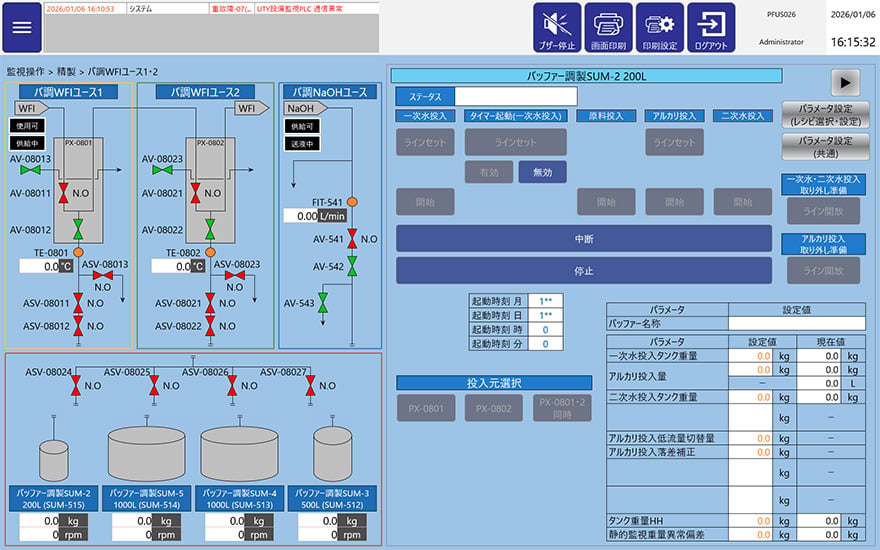
Example screens for configuration and operation of preparation equipment
“The introduction of zenon enables centralized management and automation of DI requirements which previously required manual handling,” says Hiroaki Iwama. “This is expected to improve work quality while reducing the total time spent. It will also streamline auxiliary tasks such as data review.”
Using the zenon-based supervisory control and data acquisition (SCADA) system, data is collected from devices in the new HB7 building and monitored. It is now centrally managed and consistently recorded. Resulting information can be viewed via the intuitive operator interfaces and management reports.
Hiroaki Iwama adds, “To enable the smooth transition from pilot to GMP manufacturing, we collect and manage acquired data in a consistent format within the same zenon platform. This approach accelerates development and enhances data usability.”
The user experience has been enhanced in the new facility. “Specific operations can now be shared and viewed remotely from tablet devices by authorized users anywhere. For certain equipment, operators can monitor remotely and take necessary action, as required,” explains Hiroaki Iwama. “Together with a new camera system implemented on the line, this has enabled us to significantly reduce operator workload.”
In addition, SOFTECH integrated zenon’s alarm and notification functionalities with the company’s existing production alerts. By day, staff are alerted to urgent or important events via email. For out-of-hours coverage, integration with Kyowa Kirin’s automated voice notification system is enabled using zenon Message Control. The solution ensures timely push notifications to relevant staff when an event requires attention.
HMIs at machine level offer operators an overview of alarms and trends via the zenon Chronological Event List (CEL) and zenon Extended Trend. zenon Extended Trend is used to compare production batches with a previously completed batch, ensuring high quality production. Over the longer term, these recorded parameters can be checked and revised to enable ongoing production optimization.
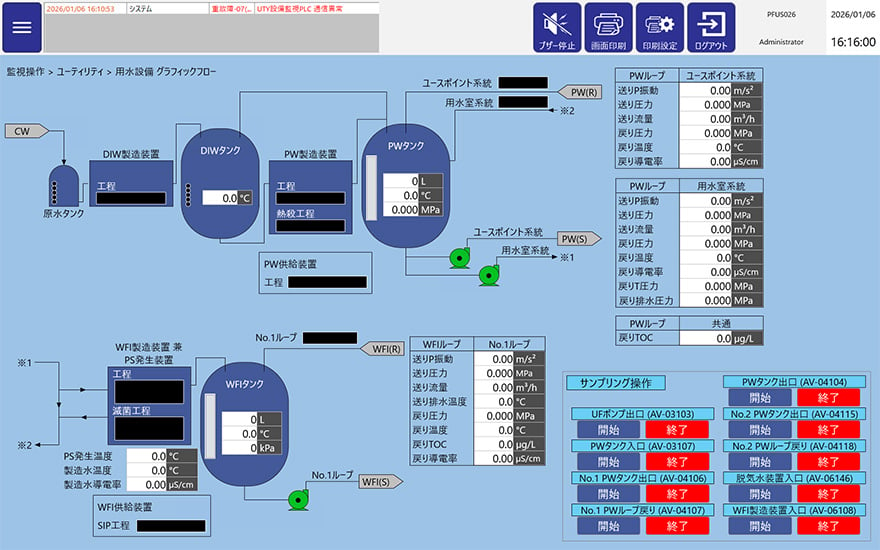 Example screens for monitoring and configuration/operation of water supply equipment
Alongside its pilot and GMP manufacturing operations, the new HB7 building at the Takasaki plant includes a new training facility, Knowledge Center, established to address a shortage of experienced biopharma engineers in Japan. This space enables staff to use zenon to perform operations that simulate actual manufacturing processes. zenon is used throughout the building to maintain the consistent approach.
As well as delivering time savings for Kyowa Kirin, the new zenon-based solution is readied for future expansion. In collaboration with Kyowa Kirin's IT team, SOFTECH achieved domain integration for IT system connectivity. The SOFTECH team built a data platform utilizing zenon Historian to support plans for further data integration, processing, and cloud connectivity going forward.
“Using zenon Historian and logging data to a SQL server, we built a solution for integrating and accumulating acquired data in zenon,” Kunihito Nonaka explains. “Working in partnership with Kyowa Kirin’s IT and engineering teams as well as with COPA-DATA has ensured that all manufacturing data is ready for future MES integration.”
The zenon-based solution delivers the redundancy for data protection capabilities that are a mandatory requirement for pharmaceutical applications. This reliability is made easy thanks to zenon’s inbuilt redundancy options. Redundancy can be easily configured simply by adjusting settings. This reduces the implementation workload.
The reliability of the strong relationship with COPA-DATA is just as important. “The support we received from SOFTECH and COPA-DATA have been superb,” says Hiroaki Iwama. “In addition to the comprehensive support from the conceptual phase by SOFTECH, we leant into the support provided by the COPA-DATA Technical Support Team as well as consultation with our COPA-DATA system integrators. It is a productive partnership and together we are achieving great things.”
The team’s choice of zenon provides an additional layer of futureproofing and extensibility. The zenon software platform supports the module type package (MTP) data standard for “plug and produce” modular production.
When equipment is added, replaced or upgraded, MTP compatibility enables the end user to swap in MTP-compliant modules faster and easier in a compliant manner, with prequalification supported. The Kyowa Kirin team recognizes that this capability will be increasingly important as the pharmaceutical industry transitions to MTP-compliant equipment and systems.
Hiroaki Iwama concludes, “Kyowa Kirin, together with trusted partners, leverages zenon as a powerful tool to continuously create life-changing value. Through advanced manufacturing technologies, we aim to deliver smiles to those facing illness as a global specialty pharmaceutical company originating in Japan."
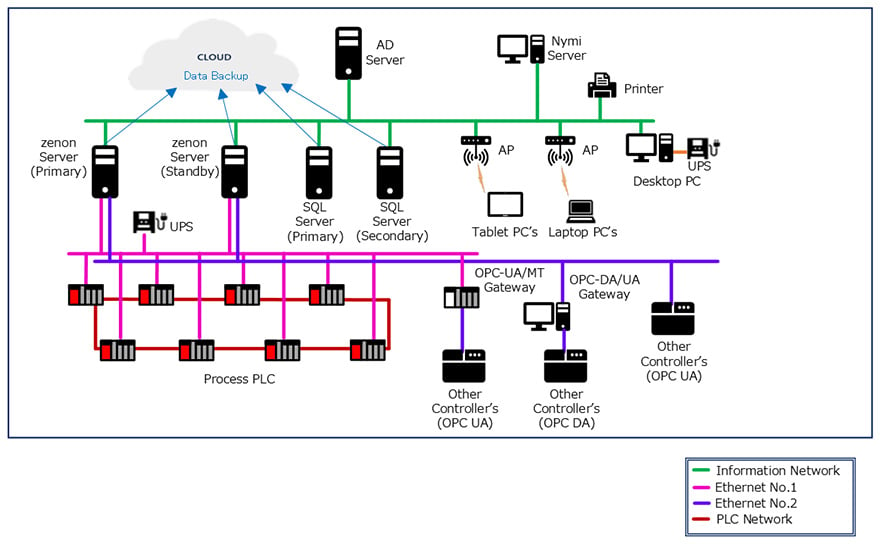 System architecture overview for the project
Success Story
Success Story