
What is IEC 61850 and how does it work?
IEC 61850 is an international standard that defines communication protocols for automation equipment in digital substations. It replaces hardwired copper connections with standardized Ethernet-based communication, enabling devices from different manufacturers to exchange data using a common language. This reduces cabling, simplifies engineering, and creates more flexible, interoperable substation designs. COPA-DATA's zenon software platform is one example of a system that integrates IEC 61850 natively, providing HMI, SCADA, and gateway functions from a single platform.
Key takeaways
-
On process-bus level IEC 61850 replaces point-to-point copper wiring with Ethernet-based communication, reducing infrastructure and enabling more adaptable substation architectures.
-
The standard defines three core communication services: MMS, GOOSE, and Sampled Values, each serving a specific role in substation automation.
-
Interoperability between devices from different vendors is built in, eliminating the need for protocol converters and custom engineering.
-
IEC 61850 is designed to evolve; Edition 1 and Edition 2.1 devices can coexist, which is critical for brownfield modernization projects.
- Native support for IEC 61850 in a SCADA/HMI platform, such as zenon, allows utilities to take full advantage of the standard without additional middleware.
Why IEC 61850 matters for substation automation?
Transitioning to a digital substation is a strategic shift that directly impacts reliability, safety, and capital expenditure. The standard delivers three core operational advantages:
-
Interoperability. Before IEC 61850, substation equipment from different vendors used proprietary protocols. Integrating a Siemens relay with an ABB relay required protocol converters, custom engineering, and ongoing maintenance. IEC 61850 solves this by specifying a common data model and communication services. Any device that conforms to the standard can exchange information with any other conforming device.
-
Reduced cabling and infrastructure. Conventional substations use copper wiring for every signal between devices. IEC 61850 replaces point-to-point wiring with Ethernet-based communication. This shrinks the physical footprint of substations, reduces material costs, and eliminates single points of failure inherent in hardwired systems.
- Future-ready architecture. The standard is designed to evolve. Edition 1 (published 2004) and Edition 2 (published 2011, with Amendment 2.1 following) are both in active use. A well-implemented IEC 61850 system accommodates devices from both editions, which is essential for brownfield modernization projects where legacy equipment must coexist with new installations.
What are the core protocols defined by IEC 61850?
IEC 61850 specifies three primary communication services, each designed for a specific function within the substation:
| Protocol | Role in the substation |
| IEC 61850 MMS (Manufacturing Message Specification) | Client-server communication for monitoring and control. MMS allows a SCADA system to read measurements, issue commands, and exchange files with IEDs. It supports both Edition 1 and Edition 2.1 of the standard. |
| IEC 61850 GOOSE (Generic Object Oriented Substation Event) | Peer-to-peer communication for high-speed protection signaling. GOOSE enables fast messaging between relays for tripping, interlocking, and other protection functions without a central server. |
| IEC 61850 Sampled Values (SV) | Transmission of digitized current and voltage measurements from merging units to protection and control devices over the Process Bus. This replaces analog copper wiring with a shared, digital data stream. |
Each of these protocols can be secured with TLS encryption (IEC 62351-3) and authentication (IEC 62351-4). Network redundancy protocols such as PRP (Parallel Redundancy Protocol) are also used to ensure zero-time failover for critical communication paths.
How does IEC 61850 enable Digital Substations?
Beyond the protocols themselves, IEC 61850 introduces a standardized engineering process and a common data model that change how substations are designed, built, and operated. The Digital Substations.
A unified data model and engineering process
IEC 61850 defines a Substation Configuration Language (SCL) that describes the entire substation: its primary equipment, protection functions, and communication networks, in a machine-readable format. This allows system integrators to:
-
Import device capabilities directly from IED configuration files.
-
Generate HMI and SCADA configurations automatically from the data model.
-
Reuse standardized templates across multiple projects, reducing engineering time and errors.
This data-driven approach replaces manual point-to-point mapping and makes multi-vendor interoperability practical at scale.
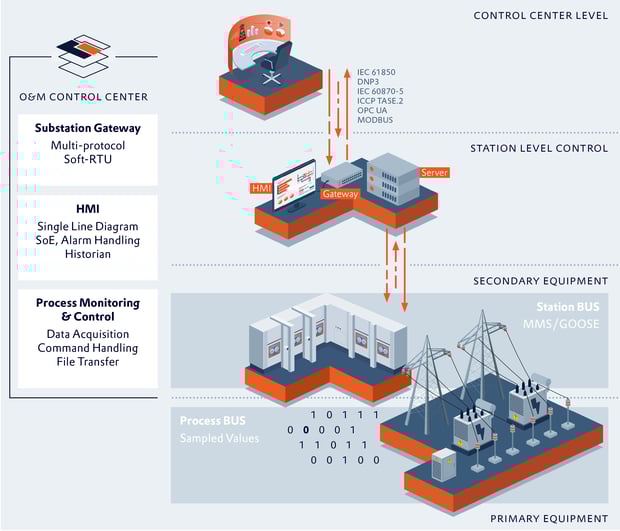
What solutions does IEC 61850 enable?
Station control and HMI
Real-time situational awareness is achieved through a single HMI that displays data from all IEDs, regardless of manufacturer or protocol edition. Operators execute commands under role-based access control, while automatic interlockings based on the actual substation topology protect equipment from unsafe operations.
Substation gateway
IEC 61850 gateways mediate between the substation's internal protocols (MMS, GOOSE, SV) and upstream control center protocols (IEC 60870-5-101/104, DNP3, ICCP/TASE.2). This enables regional and national control rooms to monitor and command substation equipment without being aware of the underlying IED details.
GOOSE communication monitoring
Even though GOOSE is a peer-to-peer protocol, an HMI/SCADA platform that can subscribe to GOOSE messages can monitor protection signals, alert operators to communication failures, and even substitute missing messages during device maintenance.

High availability networking with PRP
PRP (Parallel Redundancy Protocol) is an industry standard which provides seamless failover against any failure of any network component. All Ethernet based communication protocols in zenon, such as IEC 61850 MMS Client and Server, as well as GOOSE can be utilized on basis of PRP.
Disturbance record management
IEDs capture high-precision oscillography during grid events. IEC 61850 defines a file-transfer mechanism that allows a central system to collect and archive these disturbance records, and an integrated COMTRADE viewer can display them directly in the HMI.

Commissioning and device exchange
SCL-based engineering enables virtual simulation of devices for factory and site acceptance testing. During operation, test modes and the ability to quickly replace a failed IED using an alternative data-point driver reduce downtime and manual reconfiguration.

What should you look for in an IEC 61850 automation platform?
When evaluating a SCADA/HMI platform for IEC 61850 projects, several capabilities determine how fully the standard's benefits can be realized:
-
Native protocol support. The platform shall comprehensively implement the MMS Client Protocol. Additional availability of MMS Server and GOOSE (Publish/Subscribe).
-
Certification. Independent certification, such as Edition 2 .1conformance testing by a recognized lab, provides assurance of compliance and interoperability.
-
SCL engineering. The ability to import SCL files directly, automatically populate the HMI database, and generate visualizations from the data model eliminates manual mapping and reduces errors.
-
Vendor independence. The platform must connect to IEDs from any manufacturer and support mixed Edition 1 and Edition 2.1 environments.
-
Redundancy and availability. Support for PRP and HSR ensures that protection-critical communication survives a single network failure.
-
Security. Integrated TLS encryption and authentication according to IEC 62351 protect data integrity and confidentiality.
- Scalability. The platform should scale from small distribution substations to large transmission fleets without architectural changes.
How does zenon implement IEC 61850?
zenon integrates IEC 61850 as a native capability, not as an add-on or middleware layer. It supports the most important station-level protocols: MMS Client, MMS Server, and GOOSE Publisher/Subscriber, and is certified to Edition 2.1 by DNV GL (tested against 1,000 concurrent IEDs). Below is a closer look at what that means in practice.
Native protocol support and certification
| Protocol | zenon capability |
| IEC 61850 MMS Client | Connects to any brand of IED. Compliant with Edition 2.1. Supports static and dynamic datasets for Reporting. Certified by DNV GL for Edition 2.1. |
| IEC 61850 MMS Server | Provides data to upstream systems (RTUs, SCADA control rooms). Integrated into the IEC 61131-3 (Soft PLC) environment for maximum flexibility. |
| IEC 61850 GOOSE Publisher/Subscriber | Monitors GOOSE messages for supervision and can substitute missing GOOSE messages during component failure. Configuration via SCL file import. |
All Ethernet-based IEC 61850 services in zenon operate over PRP-redundant networks, ensuring zero-time failover. TLS encryption (IEC 62351-3) and ACSE authentication (IEC 62351-4) are built into the communication drivers.
Engineering efficiency
zenon reads SCL files directly from IEDs or engineering tools. The data model (logical devices, logical nodes, data objects) maps automatically to zenon variables, eliminating manual tag creation. For standardized projects, HMI elements such as single-line diagrams, alarm configurations, and measurement displays can be generated automatically from SCL files. This reduces project engineering time by up to 90% compared to manual methods.
Template-based engineering further accelerates deployment. Templates created for one substation can be reused across an entire fleet, ensuring consistency and reducing the risk of configuration errors. zenon's object-oriented engineering environment also supports both bottom-up (starting from existing devices) and top-down (starting from top-level system design) workflows.
Scalability and investment security
zenon scales from small installations with a few feeders to enterprise deployments managing hundreds of thousands of data points. Edition 1 and Edition 2.1 devices from any manufacturer can be integrated simultaneously within the same project. This protects existing hardware investments and allows utilities to modernize incrementally without replacing functioning equipment.
Long-term compatibility is built into the platform. COPA-DATA actively tracks the evolution of the IEC 61850 standard and provides ongoing support for new features as they are published. The platform's fully integrated engineering and runtime environment ensures that operational knowledge carries forward as the system grows.
Unified operation and lifecycle management
All IEC 61850 configuration, HMI development, and SCADA logic happen within a single engineering studio, eliminating the need to switch between tools. Operators see all substation data, whether arriving via MMS, GOOSE, DNP3, or other protocols, through a consistent HMI. The platform also includes integrated disturbance record management, commissioning support, and fast device replacement capabilities that minimize outage time during maintenance.
Discover more with our IEC 61850 eBook
Download our IEC 61850 eBook to learn more about substation modernization and how to achieve Digital Substations.
FAQs about IEC 61850
-
It is used for communication between secondary equipment, such as Merging Units, IEDs and station level HMI in digital substations. It replaces hardwired copper connections on process level with Ethernet-based data exchange, supporting monitoring, control, protection, and automation functions.
-
MMS handles client-server communication for monitoring and control: reading measurements, issue commands, and exchanging files between a SCADA system and IEDs. GOOSE handles peer-to-peer communication between protection devices: fast, event-driven messaging for tripping, interlocking, and other protection functions.
-
SCL (Substation Configuration Language) is the XML-based language that describes the substation's equipment, functions, and communication. It enables automated engineering, data model exchange, and consistent configuration across tools and vendors.
-
Yes. A platform that supports both protocols can act as a gateway, translating data and commands between DNP3 and IEC 61850. This allows utilities to operate existing DNP3 devices alongside new IEC 61850 equipment without replacing the entire system.
-
Yes. zenon reads SCL files directly from IEDs or engineering tools, automatically populating the HMI database and generating template-based visualizations from the data model.
-
zenon includes TLS encryption (IEC 62351-3) and ACSE authentication (IEC 62351-4) built into its IEC 61850 communication drivers. It is developed under an IEC 62443-4-1 certified secure development lifecycle.
-
IEC 61850 is a standard, not a single protocol. It specifies several communication protocols (MMS, GOOSE, Sampled Values), a common data model, and an engineering process for substation automation.
-
Sampled Values (SV) are digitized current and voltage measurements transmitted over the Process Bus from merging units to protection and control devices, replacing analog copper wiring.
-
The station bus connects IEDs at the bay and station levels for SCADA, control, and GOOSE messaging. The Process Bus connects the switchyard (merging units, primary equipment) to the bay level, transmitting Sampled Values and GOOSE signals over Ethernet.
-
Yes. zenon natively supports IEC 61850 MMS Client, MMS Server, and GOOSE. Its MMS Client is certified to Edition 2.1 by DNV GL, and the platform supports concurrent communication with Edition 1, Edition 2 and Edition 2.1 devices from any manufacturer.
-
zenon operates all Ethernet-based IEC 61850 services over PRP-redundant networks for zero-time failover. It also supports hot-standby server redundancy and preventive switchover to maintain continuous operation.
Future trends and development in IEC 61850 and zenon
While analyzing the role of IEC 61850 and zenon, it is important to keep future trends and developments in mind. Coping with increasing requirements, due to growing dynamics and demand for electrical energy, requires utilities to future-proof their assets and advance their operational effectiveness. As cybersecurity plays a bigger role in digitalized systems, the power industry must ensure protection against cyber threats. Additionally, the increased global emphasis on sustainability and zero-emission policies highlights the need to shut down traditional fossil energy sources in favor of distributed renewable ones. zenon is well positioned to tackle these challenges, with user interface development and smart grid solutions at the forefront of its development. We are excited to see what the future holds for our customers, IEC 61850, and zenon.
For more detailed information about the capabilities and implementation conformance of IEC 61850 related drivers and functions in zenon, please contact us.