Automation integration layer for pharmaceutical manufacturing

Bridge the gap between OT and IT. Ensure compliance with regulatory standards (data integrity) by connecting modern and legacy machines to the IT infrastructure. Provide OT data for electronic batch records (EBRs) and enable review by exception for shorter batch release times.

LS_herobanner_small_1420x757px_AutomationIntegrationLayer
Home Industries Life Sciences & Pharmaceutical Automation Integration Layer

The Automation Integration Layer (AIL) from COPA-DATA is a vendor-independent, no-code/low-code middleware built on the zenon Software Platform that connects shop floor equipment with MES, ERP, and cloud systems in pharmaceutical manufacturing.

It standardizes production data across legacy and modern machines, ensures compliant data integrity (including ALCOA+ principles), and supports regulatory frameworks such as GxP and 21 CFR Part 11.

Why life sciences and pharmaceutical manufacturing need an Automation Integration Layer (AIL)

Pharmaceutical manufacturers face growing pressure to digitalize while maintaining strict regulatory compliance and data integrity across increasingly complex, brownfield plants. At the same time, cyber threats, global competition, and serialization/traceability demands are raising expectations for real-time, high-quality production data.

Without a dedicated integration layer, every new MES, ERP, or cloud project requires custom point-to-point interfaces that are slow to implement, hard to validate, and expensive to maintain in regulated environments. An Automation Integration Layer solves this by providing a standardized, reusable integration between OT and IT.

What is the zenon Automation Integration Layer?

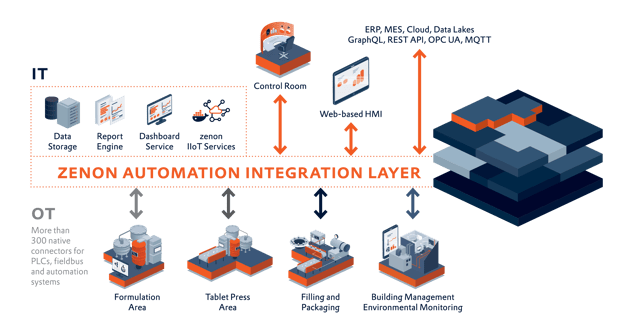
The Automation Integration Layer is a vertical data integration and middleware layer that sits between PLCs, machines, building systems, and SCADA on one side and MES, ERP, and analytics platforms on the other side. It collects, contextualizes, and harmonizes operational data and passes them on to higher level systems. They receive clean, consistent, and compliant information.

The core capabilities include connectivity to legacy and modern equipment, a plant historian, exception handling, audit trail, electronic signatures, user and recipe management, and reporting – all aligned with GAMP and data integrity expectations for regulated industries such as life sciences.

How the Automation Integration Layer works

In a typical pharmaceutical site, the AIL connects filling lines, formulation areas, tablet presses, and building/environmental systems to an upper-level MES or ERP. It maps equipment signals into ISA95-style models, enriches them with context (batch, product, line), and exposes standardized interfaces to PAS-X and other MES solutions.

This architecture reduces custom coding effort, shortens qualification activities, and allows multiple sites and lines to reuse the same integration patterns, improving maintainability, and lowering total cost of ownership.

  • Content_full_2560x800_2024_AIL-Grafik_Integration-of-legacy-equipment

    Key use cases in pharmaceutical manufacturing

    Each use case is delivered through the same reusable zenon-based Automation Integration Layer rather than isolated point solutions, reducing complexity and risk

    • Connect lines and units to MES for electronic batch recording, batch synchronization, process control, through standardized interfaces instead of many different drivers. 
    • Implement centralized user management, electronic signatures, audit trail, historian, and deviation detection as pre‑validated functions within the AIL rather than rebuilding them in each project. 
    • Aggregate production, downtime, and energy data across lines and utilities to feed OEE dashboards, continuous improvement initiatives, and sustainability reporting. 
    •  Integrate BMS and EMS to correlate environmental conditions (temperature, humidity, differential pressure) with batch data and automatically document compliance. 

    • Position the AIL as a controlled interface between OT zones and IT networks, aligning with defense in-depth with consistent security and governance. 

    Original insights and maturity perspective 

    Many life sciences plants are stuck with “digital silos”: islands of automation, standalone machinery, and interfaces that make global analytics and standardized EBR rollouts slow and expensive. Positioning the Automation Integration Layer as a strategic layer helps organizations move from siloed digitization toward a connected plant. Moving from paper-based processes to digital solutions takes time.

    Our Customers

    • Pfizer_reference_logo_480x300px
    • HarroHoefliger_reference_logo_480x300px
    • Biotree_reference_logo_480x300px
    • Romaco_reference_logo_480x300px
    • Novartis_reference_logo_480x300px
    • RocheDiagnostics_reference_logo_480x300px
    • MuellerCleaning_reference_logo_480x300px
    • Sanofi_reference_logo_480x300px
    • Baxter_reference_logo_480x300px
    • ImaPharma_reference_logo_480x300px
    • Merck_reference_logo_480x300px
    • BauschStroebel_reference_logo_480x300px
    • DrReddys_reference_logo_480x300px
    • BrevettiCEA_reference_logo_480x300px
    • ACGWorldwide_reference_logo_480x300px
    • BoehringerIngelheim_reference_logo_480x300px
    • Skan_reference_logo_480x300px
    • Lifescan_reference_logo_480x300px
    • AstraZeneca_reference_logo_480x300px

      Easy to comply with data integrity regulations also on old and existing machines

      Reduce headache for quality assurance and be prepared for an inspection.

      The zenon AIL's parameter tracking and data recording features allow for data integrity compliance out of the box and provide an easier life for quality assurance. You can centrally monitor and log GMP parameter changes and receive instant notifications when one of these values changes without authorization. zenon's recordkeeping capabilities store the data permanently in a central location. This is also simplifying the Backup and Restore operations and is required by regulations.

      Recorded data can be easily distributed across the company using web technology or via predefined reports as pdf.

      In this way, important information like audit trail or exception detection can be easily handled by the QA department during the batch review.  

      zenon Automation Integration Layer - connect machines to insights

      The zenon Automation Integration Layer (AIL) is a lightweight, secure middleware that standardizes and speeds data flow from plant equipment to MES, historians and cloud services. On the shop floor the zenon Automation Integration Layer provides robust PLC connectivity (OPC UA, Modbus, native drivers), exposes batch/ISA‑88 data and recipes for MES coordination, aggregates packaging‑line signals and vision inputs for traceability and fault diagnosis, collects high‑frequency filling‑line metrics (weights, speeds, rejects) for quality control, and supplies synchronized machine states and counts for accurate OEE calculation.

      The result is faster, lower‑effort integrations, a unified data model for reliable analytics and a scalable, vendor‑agnostic bridge from machines to enterprise systems.

      More efficient validation due to GAMP5 SW Cat. 4

      The zenon Software Platform is a configurable product according to GAMP5 SW category 4. This reduces time and costs for validation. The clear project structure provides a good overview and you can keep all project know-how in-house.

      Stay independent from suppliers and keep operational information classified.

      The history of change, integrated within the engineering environment, tracks all modifications done within the separate project versions, providing documentation for the change control phase according to GAMP5.

      A documentation wizard documents all the configuration settings of the project for the easy creation of the documentation required for the validation process.

      Solutions from COPA-DATA

      With the zenon pharmaceutical digitalization layer, you can streamline your legacy machines and modern software to improve efficiency and agility.

      COPA-DATA has more than 30 years of experience in software development and continually updates zenon to adapt to changes in technology.

      For more information, contact COPA-DATA today.

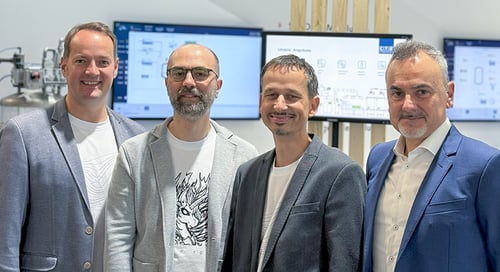
      Contact_Image_890x485px_LifeScienceTeam
      Industry Management
      Life Sciences & Pharmaceutical | Process Industry
      Contact us

      FAQs

      •  Yes, the zenon Automation Integration Layer (AIL) is specifically designed to integrate legacy equipment. It uses over 300 native drivers to connect to older PLCs and machines without requiring you to replace existing hardware. This allows you to modernize brownfield facilities and bring them into a connected Industry 4.0 environment by breaking up data silos. 
      •  Absolutely. The Automation Integration Layer (AIL) serves as a vertical data bridge between Operational Technology (OT) and Information Technology (IT). It aggregates and contextualizes production data from the shop floor and shares it with MES, ERP, and cloud systems using standard interfaces like OPC UA and REST APIs. 
      •  The Automation Integration Layer (AIL) is a middleware solution powered by zenon software that bridges the gap between shop floor equipment and IT systems. It connects legacy machines and modern devices to upper-level systems like MES and ERP, creating a unified data network for your entire pharmaceutical production facility. 
      •  The AIL can act as a controlled integration layer between OT zones and IT systems, supporting defense in-depth architectures and alignment with standards such as IEC 62443. It centralizes access, logging, and data flows, which improves visibility and reduces the attack surface for critical production systems. 

      •  The zenon Automation Integration Layer (AIL) ensures data integrity out of the box. As GAMP5 Category 4 software, it includes built-in features for user access control, audit trails, electronic signatures, and historian functions that fully comply with FDA 21 CFR Part 11 and EU GMP Annex 11 regulations. 

      •  The Automation Integration Layer (AIL) simplifies validation because it is a no code / low code software product based on open standards, rather than a custom-coded solution. It comes with validation documentation wizards and project change tracking, which streamlines the qualification process (IQ/OQ/PQ) and reduces the validation effort by up to 80% compared to custom scripts. 
      •  zenon ensures data integrity by centrally tracking GMP-critical parameters, recording all changes with a secure audit trail, and detecting unauthorized modifications. Data from legacy equipment is collected, time-stamped, and stored in a controlled environment. This approach supports regulatory expectations for data accuracy, completeness, and traceability. 

      Features explained

      zenon Logic

      zenon Logic comes with Logic Studio, a programming environment that complies with the IEC 61131-3 standard. This means that it is flexible. The code is compiled and then runs in Logic Service as a virtual PLC. This means that it is fully integrated into Engineering Studio, which makes setting up projects easier and more reliable.

      Audit Trail

      Custom audit trail implementations require extensive development, validation documentation, and ongoing maintenance. And one gap in your tracking? That's a regulatory finding waiting to happen. zenon already meets the requirements of the FDA 21 CFR Part 11 and EU GMP Annex 11 regulations.

      PAS-X MSI interface

      zenon's certified MSI interface makes it easy to send batches of data between PAS-X MES and your equipment. It can also send GMP alarms to the MES. This certified integration helps reduce errors, speed up batch release, and minimize downtime between batches, while delivering the flexibility required in modern life sciences facilities.


      • LS_Content_full_2560x800px_AutomationIntegrationLayer

        zenon complies with FDA 21 CFR Part 11 and Annex 11 

        • LS_Content_full_2560x800px_AutomationIntegrationLayer

          zenon complies with FDA 21 CFR Part 11 and Annex 11 

          Information material

          • Pdf

            Automation integration layer for pharmaceutical manufacturing

            Digitalization_AIL_SL_EN.pdf
            Get file now

            I'm COPA-DATA's AI Assistant and happy to help with general info. Got any questions?