What is the difference between a digital substation and a virtualized substation?

A digital substation changes how devices communicate, replacing copper signal wiring with Ethernet-based communication such as IEC 61850. A virtualized substation changes where the software runs, moving automation functions from dedicated hardware onto shared infrastructure. They apply to different layers of the system. You can have one without the other, and one depends on the other.

Herobanner_small_1420x757px_Digital-vs-Virtualized-Substations
Home Industries Energy & Infrastructure Overview Digital vs Virtualized Substations

Key takeaways

  • Digital and virtualized describe different layers. Digitalization is about communication. Virtualization is about where software executes.

  • A substation can be digital without being virtualized, which is where most utilities are aiming to be today.

  • Virtualization of protection functions in practice depends on a digital foundation, since the communication layer is what makes shared computing infrastructure viable.

  • The two are sequential in one direction, not interchangeable, so the useful question is not which one but which one first.

  • IEC 61850 underpins both. It defines the communication layer for digital substations and provides the data foundation that virtualization depends on.

  • zenon supports both and connects to legacy protocols alongside IEC 61850 so hybrid substations run on one platform.

The two layers of substation modernization

Substation modernization is often described as a single trend. In practice it happens at two distinct layers. When teams compare substation virtualization vs digitalization, they are usually comparing changes at different layers of the same system, and the two terms refer to each one separately.

Digitalization addresses the communication layer. It replaces the copper wiring that conventionally carries signals between switchyard equipment and the control room with Ethernet-based communication. The standard that defines this is IEC 61850, which specifies a common data model and the services devices use to exchange information. Digital substations use fiber-optic cables, merging units that digitize measurements at the source, and a process bus that publishes those measurements to every device that needs them. We cover this in more detail in our article: What is a Digital Substation? 

Virtualization addresses the software and infrastructure layer. It moves protection, automation, and control functions (PAC) from dedicated hardware devices onto shared computing infrastructure. An HMI server or a gateway also becomes a software instance running on a server that hosts several of them. The industry term for the protection side of this model is vPAC, or virtual Protection, Automation and Control. Station-level virtualization, covering HMI, SCADA, and gateway functions, is the more common starting point. We cover this in more detail in our article: What is substation virtualization?

The two are sequential in one direction. Digitalization is a change utilities can make on their own, and adoption is growing, though digital substations still represent a small fraction of the global fleet. Virtualization assumes the communication layer is in place, because shared infrastructure relies on device data being available over the network. That dependency is what makes the comparison worth understanding.
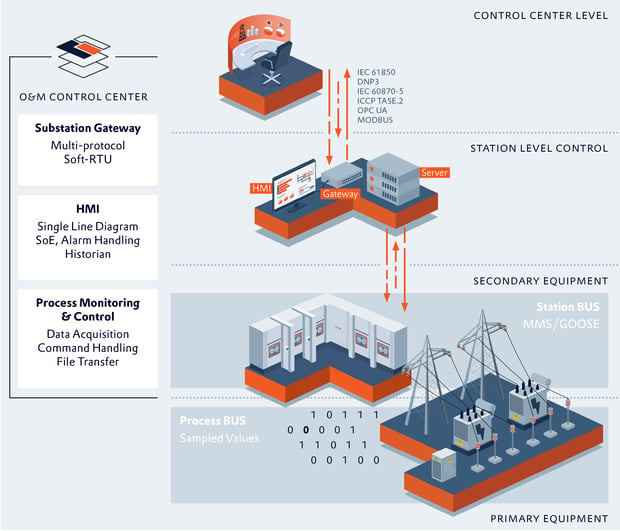
  • 2023_SLF_IEC_61850_Landscape-Elements-Grafik_700px
    • 2023_SLF_IEC_61850_Landscape-Elements-Grafik_700px

      How are they different?


        Digital substation Virtualized substation
      What changes How devices communicate Where software runs
      From Copper signal wiring Dedicated hardware devices (IEDs)
      To Ethernet-based communication using IEC 61850 (SV and GOOSE) Shared computing infrastructure (Hypervisors, VMs, Containers)
      Prerequisite IEC 61850 compliant equipment from vendors IEC 61850 digital process bus, connecting merging units to centralized PAC

      The prerequisite row is the one that matters. Both paths depend on IEC 61850, but at different levels. A digital substation needs compliant equipment that speaks the standard. A virtualized substation needs the digital process bus specifically, because that is what makes merging unit data available to centralized protection, automation, and control over the network. A utility can build a digital substation without virtualizing anything. It cannot virtualize the protection layer without the process bus already in place.
      Which comes first, digitalization or virtualization?

      Digitalization comes first, and this is not simply a matter of preference. A digital substation is a self-contained change. The signals move from copper to Ethernet, and the benefits are available immediately without any change to where the software runs. Utilities adopt IEC 61850 for new or refurbished substations while continuing to run their automation software on dedicated hardware.

      Virtualization depends on the same foundation. When several functions share computing infrastructure, they need to receive their data over the network. That is what IEC 61850 provides. A utility that has not digitized its substations can still virtualize station-level software in some cases, but the integration effort is higher and the benefits are narrower, because the data layer is not standardized.

      This is why the two are sequential in one direction. Digital first is not a requirement in every deployment, but it is the path that makes virtualization practical at scale.

      How does IEC 61850 enable both?

      IEC 61850 is the common thread. It is the standard that defines communication for digital substations, and it is also what makes virtualized architectures viable.

      For a digital substation, IEC 61850 is the communication layer itself. It specifies MMS for client-server communication on station level, GOOSE for high-speed protection messaging, and Sampled Values for digitized measurements over the process bus. It also defines a common data model and an engineering process based on SCL files, so devices from different manufacturers can be configured and operated consistently.

      For a virtualized substation, IEC 61850 provides the data foundation. When station-level functions run as software on shared infrastructure, they need standardized access to device data over the network. IEC 61850 delivers that. A virtualized HMI or gateway is not reading from a dedicated point-to-point connection. It subscribes to data published on the network, which is exactly what the standard was designed to enable.

      The same engineering process carries across both. SCL files that describe a substation's topology and device configuration are used to generate HMI configurations in a hardware-based digital substation, and the same files feed the same automation layer when that layer runs in a virtual machine. The data model does not change because the execution environment changed.

      This is why IEC 61850 adoption is the foundation for either path. A utility that has standardized on the communication layer can digitize and virtualize incrementally, without re-engineering the data model at each step.

      • Content_full_2560x1500_Virtual-vs-Digitalized-Substations

        How does zenon support the modernization process?

        zenon Energy Edition sits in both layers. It integrates IEC 61850 natively, including MMS Client, MMS Server, and GOOSE Publisher and Subscriber, so it operates as the station-level platform in a digital substation. It also runs in virtual machines and containers, so it can be deployed on shared infrastructure in a virtualized environment.

        What makes this practical for utilities mid-migration is that zenon connects to legacy protocols alongside IEC 61850 in the same project. DNP3, IEC 60870-5-101/104, Modbus, and OPC UA run alongside MMS, GOOSE, and Sampled Values, which means a hybrid substation with some IEC 61850 bays and some conventional bays operates through one platform and one operator interface. A utility does not need to complete the digital transition before starting the virtualized one.

        zenon is not a vPAC platform and does not provide protection functions. It provides the station-level layer and integrates with protection systems, whether those run on dedicated devices or on virtualized protection platforms. As a utility digitizes and then virtualizes gradually, the station-level software layer remains consistent.

        blueBox_image_3000x1200px_Digital-vs-Virtualized-substations

        Discover how substation virtualization can be achieved

        In this exclusive webinar, our team of COPA-DATA experts discuss how this type of architecture can be achieve through zenon.

        Access the webinar

        FAQs about digital and virtualized substations

        • A digital substation changes how devices communicate, replacing copper wiring with Ethernet-based communication according to IEC 61850. A virtualized substation changes where software runs, moving it from dedicated hardware onto shared infrastructure. They apply to different layers.

        • For protection functions, in practice, yes. Virtualizing protection depends on a digital or digital-ready foundation, because shared infrastructure assumes device data is available over the network. Some station-level functions can be virtualized without full digitalization, but the integration effort is higher and the benefits are narrower.

        • vPAC stands for virtual Protection, Automation and Control. It describes protection and control functions running as software and centralized on a common server host rather than as dedicated relays. It is the protection-focused side of substation virtualization.

        • No. Virtualization builds on the digital foundation rather than replacing it. A virtualized substation is generally also a digital substation.

        • Yes. zenon integrates IEC 61850 natively and runs in virtual machines and containers, so it operates as the station-level platform in both environments. It also connects to legacy protocols, which is what makes hybrid substations practical.

        • Yes. Among utilities that have already digitized, it is the most common state. Most utilities are still planning that transition, and continue to run automation software on dedicated hardware while adopting IEC 61850 for new or refurbished substations.

        • Digitalization comes first in practice. It establishes the communication foundation that virtualization depends on. Virtualization is then adopted gradually, often starting at the station level.

        • Station-level virtualization runs station-level functions such as the HMI, SCADA, and gateway in a virtualized environment, while protection and control remain on dedicated devices or specialized platforms. It is the more common starting point because these functions do not carry the same real-time constraints as protection.

        • Yes. Most utilities could operate all three at once for years. The transition happens substation by substation as equipment reaches the end of its service life.

        Choose zenon for all your digital substation needs

        Managing or entering the digital substation market can feel overwhelming.

        Luckily, zenon can simplify this process. zenon is designed for flexibility, meaning it is optimized for on-site and remote maintenance, whether you need to take a manual approach or focus on automation.

        For more information, contact COPA-DATA today!
        Contact_Image_890x485px_EnergyTeam
        Energy and Infrastructure Industry Management
        Contact us
        I'm COPA-DATA's AI Assistant and happy to help with general info. Got any questions?